
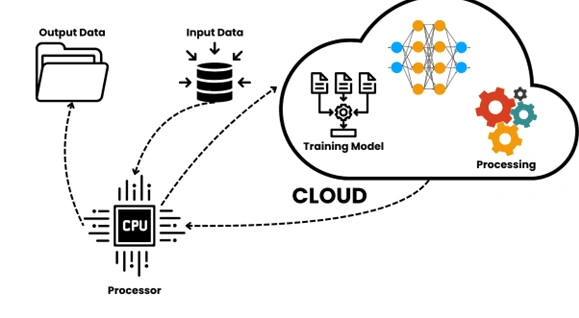
Machine learning development is becoming increasingly dependent on cloud technology. Organizations no longer need to build every machine learning environment from the ground up or maintain large collections of specialized hardware. Cloud applications provide access to scalable computing resources, managed data services, development tools, and deployment environments that can support the entire machine learning lifecycle.
This shift is particularly important as businesses move from experimenting with machine learning models to deploying them in real-world applications. A successful machine learning project requires much more than training an algorithm. Teams must collect and process data, develop models, evaluate performance, deploy models, monitor results, and continuously improve them.
By working with a cloud application development company, businesses can connect these stages through a more flexible and scalable development environment while reducing the complexity of managing cloud infrastructure and machine learning workflows.
What Is Machine Learning Development?
Machine learning development involves creating software systems that can learn patterns from data and use those patterns to make predictions, classifications, recommendations, or other decisions.
A typical machine learning development lifecycle may include:
- Data collection
- Data cleaning and preparation
- Feature engineering
- Model selection
- Model training
- Model evaluation
- Model deployment
- Performance monitoring
- Continuous retraining and improvement
Traditional development environments can make some of these stages difficult to scale. Large datasets may require substantial storage, while model training can require significant CPU or GPU resources.
Cloud applications address many of these challenges by allowing teams to provision resources when they need them and scale infrastructure according to workload requirements.
Why Cloud Applications Matter for Machine Learning
Machine learning workloads can vary significantly. A development team may need modest computing resources while experimenting with a model but substantially more processing power during large-scale training.
Cloud infrastructure makes it possible to adjust computing capacity without purchasing and maintaining permanent hardware.
For example, a team developing a computer vision model could use scalable GPU resources during training and reduce computing capacity when training is complete. This flexibility can make machine learning infrastructure easier to manage.
Cloud applications can also provide managed services for databases, storage, APIs, containers, monitoring, and security, allowing developers to focus more of their time on the machine learning application itself.
Cloud-Based Data Processing
Data is the foundation of machine learning. However, raw data is rarely ready to be used directly by a model.
It may contain missing values, duplicate records, inconsistent formats, irrelevant information, or other quality issues. Preparing this data can become challenging when datasets grow to millions or billions of records.
Cloud applications can provide scalable storage and data processing environments that support large machine learning pipelines.
A cloud-based architecture may include:
Data sources → Cloud storage → Data processing → Feature engineering → Model training → Model deployment
This structure allows organizations to build repeatable data workflows rather than manually preparing datasets for every experiment.
Scalable Model Training
Model training can be computationally expensive, especially for deep learning applications.
Cloud computing allows development teams to access CPUs, GPUs, and other specialized infrastructure without purchasing physical servers. Teams can select resources based on the complexity of their models and the size of their datasets.
For example, a small classification model may require relatively limited resources, while training a large neural network may require multiple GPUs.
The ability to scale infrastructure helps machine learning teams experiment with different architectures and datasets without being restricted by the capacity of local hardware.
Machine Learning APIs and Cloud Applications
Machine learning does not always need to be built entirely from scratch.
Cloud platforms can provide APIs and managed services for common machine learning capabilities such as:
- Image analysis
- Speech recognition
- Natural language processing
- Text classification
- Translation
- Recommendation systems
- Forecasting
- Document processing
Developers can integrate these capabilities into cloud applications through APIs.
For example, a business application could send customer documents to a machine learning service, receive extracted information, and store the results in a cloud database.
This approach can significantly reduce development time for use cases that do not require a completely custom model.
Containers and Machine Learning Development
Containers have become an important technology for deploying machine learning applications.
A machine learning model may work correctly in a developer’s environment but encounter problems when moved to another server because of differences in libraries, dependencies, operating systems, or configurations.
Containerization helps package the model and its required dependencies into a consistent environment.
A cloud-based machine learning application might use containers for:
- Model inference
- Data processing
- API services
- Background jobs
- Model training
- Testing environments
Container orchestration can then help organizations manage multiple services and scale them as demand changes.
MLOps: Connecting Development and Operations
As machine learning applications become more complex, organizations need processes that go beyond traditional software development.
This is where MLOps becomes important.
MLOps combines machine learning development with practices from software engineering and operations. It focuses on automating and managing the machine learning lifecycle.
A mature MLOps workflow can include:
Data → Training → Validation → Model registry → Deployment → Monitoring → Retraining
Automation can reduce manual work and make it easier to reproduce experiments and deployments.
For example, when new training data becomes available, an automated pipeline could validate the data, retrain a model, evaluate its performance, and deploy the new version if it meets predefined criteria.
Real-Time Machine Learning Applications
Cloud applications also make it easier to build machine learning systems that respond to events in real time.
Consider an e-commerce platform. When a customer searches for a product, a machine learning model could analyze the search query and user behavior to generate personalized recommendations.
The workflow could look like:
User request → Cloud application → Machine learning API/model → Prediction → Application response
Similar architectures can support fraud detection, predictive maintenance, demand forecasting, cybersecurity monitoring, and customer personalization.
Cloud-Based Machine Learning for Mobile and Web Applications
Machine learning can also become part of consumer-facing applications.
A mobile application may use cloud-based machine learning for features such as personalized recommendations, image recognition, intelligent search, language processing, or predictive notifications.
Instead of running a large model entirely on the user’s device, the application can send selected information to a cloud-based inference service and receive a prediction.
However, developers must consider latency, connectivity, privacy, and data transfer requirements when designing this architecture.
For some use cases, a hybrid approach may be better, with smaller models running on the device while more computationally intensive processing happens in the cloud.
Security and Data Privacy
Machine learning applications frequently process sensitive or valuable information. Cloud-based development therefore requires careful attention to security.
Organizations should consider:
- Identity and access management
- Encryption in transit and at rest
- Secure APIs
- Network segmentation
- Secrets management
- Data access policies
- Logging and monitoring
- Model access controls
- Data retention policies
Security should be incorporated into the architecture from the beginning rather than treated as a final development step.
Monitoring Machine Learning Models
Deploying a machine learning model is not the end of development.
Model performance can change over time because real-world data changes. This phenomenon is commonly associated with data drift or model drift.
For example, a recommendation model trained on historical purchasing behavior may become less accurate if customer preferences change significantly.
Cloud monitoring systems can help teams track:
- Prediction accuracy
- Latency
- Error rates
- Input data changes
- Resource utilization
- Model versions
- API performance
These metrics can help development teams identify problems and determine when a model needs to be retrained.
Cloud Application Architecture for Machine Learning
A modern machine learning application may use several cloud components rather than a single service.
A simplified architecture could look like this:
Data Sources
↓
Cloud Storage
↓
Data Processing Pipeline
↓
Feature Store / Prepared Dataset
↓
Model Training Environment
↓
Model Registry
↓
Cloud Inference API
↓
Web or Mobile Application
A monitoring layer can operate across the entire architecture to track application and model performance.
This architecture allows individual components to evolve without requiring the entire system to be rebuilt.
Challenges of Cloud-Based Machine Learning
Although cloud applications provide significant advantages, machine learning development in the cloud also introduces challenges.
Cloud Costs
Large-scale training and inference can become expensive if resources are not managed carefully. Teams should monitor usage, optimize workloads, and shut down unnecessary resources.
Data Transfer
Moving large datasets between environments can introduce latency and additional costs. Data architecture should therefore be designed carefully.
Vendor Dependency
Organizations that rely heavily on proprietary cloud services may find it difficult to move workloads between providers. Using portable technologies such as containers and standard APIs can help reduce this risk.
Model Complexity
Advanced machine learning systems can require specialized infrastructure and experienced engineering teams. Simply moving an existing model to the cloud does not automatically create a production-ready machine learning application.
Best Practices for Cloud Machine Learning Development
Organizations planning to build cloud-based machine learning applications should consider several best practices.
Start with a clear use case.
Define the business or user problem before selecting a machine learning technology.
Build a reliable data pipeline.
Poor-quality data can limit model performance regardless of how advanced the algorithm is.
Automate repetitive processes.
Use automated pipelines for testing, training, validation, and deployment where appropriate.
Design for scalability.
Consider how infrastructure will behave as datasets, users, and prediction requests increase.
Monitor models after deployment.
Production performance should be tracked continuously rather than evaluated only during development.
Prioritize security.
Protect training data, models, APIs, credentials, and user information throughout the application lifecycle.
Control cloud costs.
Choose appropriate compute resources and scale them according to actual demand.
The Future of Cloud Applications and Machine Learning
The relationship between cloud applications and machine learning development is likely to become even stronger as AI becomes a standard component of modern software.
Organizations are increasingly moving from isolated machine learning experiments toward production systems that can process real-time data and deliver intelligent features directly to users.
Cloud infrastructure provides the scalability and flexibility needed to support this transition, while MLOps, containers, APIs, and automated pipelines help development teams manage increasingly complex systems.
The result is a development environment where machine learning can become part of a broader application architecture rather than remaining a separate experimental project.
Conclusion
Cloud applications have changed the way organizations approach machine learning development. Instead of relying entirely on local infrastructure, development teams can use scalable computing, cloud storage, managed data services, APIs, containers, and automated deployment pipelines to build and operate machine learning systems.
The most successful implementations, however, are not simply about choosing a cloud provider. They require thoughtful architecture, reliable data, effective model development, strong security, continuous monitoring, and disciplined cost management.
As businesses continue integrating intelligent features into web, mobile, and enterprise software, cloud-based machine learning development will remain an important foundation for building scalable and production-ready applications.

